


Greece Aircraft Disinsection Requirements, Effective 2025
As of September 18, 2025, Greece has implemented mandatory aircraft disinsection measures to prevent the introduction and spread of Aedes aegypti and other mosquito species capable of transmitting vector-borne diseases. The regulation, outlined in AIP Greece AIC 03/25, applies to all aircraft, including private, commercial, and military flights arriving from or via countries identified by the Greek Ministry of Health as mosquito-risk areas.
While Greece is the latest country to formalize new vector control measures, Italy has long maintained aircraft disinsection requirements. However, recent updates and stricter enforcement in 2025 have caused confusion and operational delays for many business aviation operators. That experience shows why careful planning, documentation, and coordination with ground handlers remain essential for smooth arrivals into Greece.
Why This Matters
The directive aligns with International Health Regulations (IHR 2005) and WHO guidelines for vector control at points of entry. It reflects growing public health concerns across Europe about re-emerging mosquito-borne illnesses such as dengue and chikungunya.
Operators arriving from affected regions must ensure compliance before landing in Greece or risk being delayed, quarantined, or ordered to perform on-site treatment.
Lessons from Italy’s Experience

Italy’s long-standing disinsection rules became more strictly enforced in 2025, and operators encountered inconsistent application, unclear documentation requirements, and confusion over acceptable treatment methods.
Some airports accepted WHO-compliant aerosol spraying, while others required proof of residual disinsection performed by certified applicators. These inconsistencies created last-minute delays, additional costs, and operational uncertainty.
Greece’s implementation appears more standardized, but similar interpretation issues could occur at local airports. The Italian experience highlights the importance of verifying requirements directly with your ground handler and keeping complete disinsection certificates on board.
Scope and Applicability in Greece
- All aircraft arriving from or transiting through countries where Aedes aegypti or other target mosquito species are present or pose a risk of establishment.
- Applies to both civil and military operations.
- Exemptions apply only to single and two-seat fighter jets and combat helicopters, unless transported by ship.
A current list of affected countries is maintained by the Greek Ministry of Health and the National Public Health Organization (EODY). Operators should confirm the latest version through their handler or consult EODY at https://eody.gov.gr for up-to-date mosquito risk area information.
Approved Disinsection Methods
Operators must apply one of the following WHO-approved vector control procedures before arrival:
- Residual disinsection: Application of an approved biocide to all interior surfaces by licensed personnel under scientific supervision.
- Aerosol (in-flight) disinsection: Cabin and cargo areas sprayed in accordance with WHO procedures before landing.
Passengers with respiratory or allergy sensitivities must be allowed to disembark before spraying, with baggage left on board until completion. Any unused aerosol containers must remain on board for inspection by airport health authorities.
Required Documentation
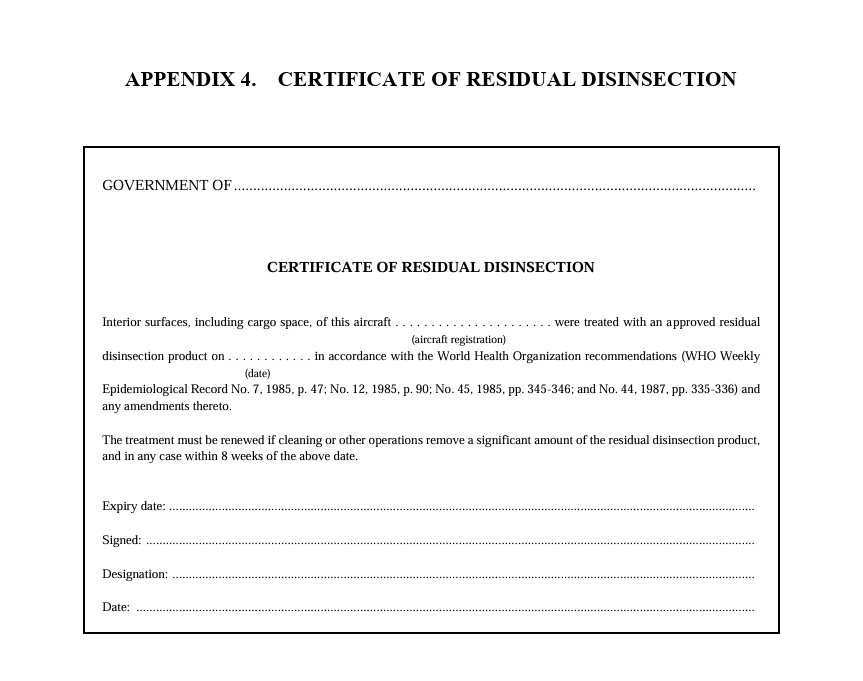 Aircraft must carry and present the following:
- Certificate of Residual Disinsection (ICAO Annex 9, Appendix 4)
- General Declaration noting details of the disinsection procedure (ICAO Annex 9, Appendix 1)
Copies must be retained for at least three months and made available to authorities upon request. Failure to provide valid certificates may result in the aircraft being isolated on arrival and prevented from refueling, embarking, or disembarking passengers until treatment is verified.
Oversight and Enforcement
Inspections are conducted by:
- The Aero-Health Authority at Athens International (LGAV)
- Regional Public Health and Health Control Services at other civil airports
- Military Health Services at defense airfields
At mixed-use airports, coordination between civil and military health officers determines final authority.
Practical Steps for Business Aviation Operators
- Confirm if your departure or tech stop is listed as a mosquito-risk area.
- Plan disinsection in advance to ensure a certified operator and approved biocide are available.
- Verify local interpretation with your handler, especially during the first months after implementation.
- Keep documentation consistent across all flights to Greece, regardless of aircraft type or operation category.
- Monitor updates from the Greek Ministry of Health and Universal Aviation Greece for enforcement changes.
Bottom Line
Greece’s aircraft disinsection rule is now in force, and operators should expect continued scrutiny of vector control compliance through the 2025–2026 travel seasons. Italy’s long-standing but recently tightened rules show how inconsistent interpretation and documentation issues can disrupt operations. By planning ahead and verifying requirements locally, operators can minimize risk and ensure seamless arrivals.
References:
- AIP Greece AIC 03/25 – Aircraft Disinsection through Implementation of Vector (Mosquito) Control Measures (effective 18 SEP 25)
- Certificate of Residual Disinsection (ICAO Annex 9, Appendix 4)
- General Declaration noting details of the disinsection procedure (ICAO Annex 9, Appendix 1)